Saturday, November 17, 2007

Proud to be an American

[Along with some political photos, I'm including some photos from recent visits by our favorite Americans and non-Americans.]
I cannot believe that I cried during a speech by French President Nicolas Sarkozy, but it’s true. Furthermore, I can hardly believe it took a French presidential address to the U.S. Congress to make me feel really proud to be an American, but that’s what happened. The only other time since we got here that I’ve felt this way was when I walked through the D-Day cemetery with my parents, Josh and three French friends. In both cases, it was a powerful reminder that America has stood for courage and freedom in real and absolute ways. It can be a rough thing to be an American abroad in times such as these. I have regularly fielded the question, “But what happened in 2004?” or “Does your country really support the war?” or “Is America really ready for a woman or an African-American as president?” or just “Who will be the next president?” Today over lunch with a Turkish friend I asked, as I usually do with a bit of trepidation, “So, how are our countries getting along?”

[Side note: Once I asked that same question to my Turkish friend, but my Canadian friend chimed in by saying, “Well, there is the US/Canadian water crisis” I was dumbstruck and asked sheepishly, “We are having a water crisis?” She said, “Yes, you keep stealing our water from the Great Lakes, and what are we going to do, send our Mounties to get you?” ]

In the face of such questions, I usually do the best I can to talk about the America I know—the one that works hard, the one that believes in freedom, the one that still thinks that anyone can be president, the one that understands that sacrifice is a necessary part of freedom, the one that never actually used the term “Freedom Fries”.

I am less able to answer specific political questions in any helpful way. I fumble and sometimes find myself angry at the fact that I even have to entertain these questions. Sometimes all I can mumble is, “I didn’t vote for Bush and I don’t know who will be the next president.” Today I found myself in the rather odd and uncomfortable position of trying to describe “single issue abortion voters” to two friends who are fiercely proud that their countries are secular (and therefore, as I understand it, without the extremely religious driving major policy decisions).

But when Sarkozy was able to take a typically French view of history, which looks at history in terms of centuries (not days or months or even years) I was reminded why I am proud to be an American in France. Sarkozy seemed genuine in his appreciation of George Washington. He was downright moving as he talked about the sacrifice of American soldiers during WWI. His description of parents teaching the role of America to their children by taking them through American cemeteries from WWII was what made me tear up. It may all be just talk and rhetoric, but I loved it and so did the members of Congress who kept applauding.


America may or may not have it “right” in a lot of ways right now. We may not ever really be the perfect country that we hope for and that the world expects, but I think we still have a lot to teach and I reveled in the sentimentality and seemingly genuine admiration of America by a French president.

When I saw a French friend of mine today for lunch, she greeted me with a slightly devious smile and the comment, “You liked Sarkozy’s speech, didn’t you?” I admitted I was fond of it and she agreed that it clearly signified a warming in U.S.-French relations. She was a bit embarrassed that Sarkozy didn’t give the speech in English, and then went on to talk about all of the other European leaders who have come to France and given speeches in French. I countered that his 60 Minutes interview was in English and I thought the CNN translator was perfectly fine. I also said “I’m really glad it was Sarkozy talking to our Congress rather than the other way around.” We then talked a bit about which French president’s liked the US. Who knew? Charles de Gaulle really only tolerated us?

She also made sure to emphasize that the speech also made it very clear that just because it is an ally, France doesn’t have to always agree with us. Even in our casual conversation, the pride in French leadership was evident.

In contrast, however, I was told by my Turkish friend that the speech also got headlines in Turkey. It read: “Fido visits US Congress”. Apparently the Turks, who are not so fond of the French, refer to Sarkozy as Fido in order to conjure up images of a small annoying dog who barks a lot. Oh, EU politics are complicated.

It may be too early to judge what kind of president Sarko the American (as he’s known here) will become. In the election, I was pulling for his opponent and have been a bit skeptical of him. He is doing some potentially creepy things with immigration and who knows if he will get any major reforms passed. The transportation strike that we are in the midst of is going to be a key test of Sarkozy's abilities and legacy. But for now, I am grateful to him for having the right words to give me back a bit of pride in America. I guess it goes to show that all politics really is local in its own international sort of way.

sPg

Wednesday, November 14, 2007

Beaujolais Blue Balls

[Sara is sleeping, or else I never would have been able to sneak this blog’s title through…]

Maybe you remember the old Paul Masson wine TV commercials, featuring Orson Welles, with the tagline “We will sell no wine before its time.”

(I know, I know, there are no commercials on PBS, maybe there was a pledge drive that week, so sue me…)

Well, no wine better lives up to the “no wine before its time” (or, frankly, “no wine before it’s time,” grammar inside joke, note the apostrophe) mantra like Beaujolais Nouveau. Whereas most wines are made with aging in mind (if not in practice), the Beaujolais is meant to be imbibed right away. And by “right away,” the French mean at or after midnight on the third Thursday of November.

Ya gotta love Wikipedia—apparently, when Beaujolais got its AOC (kind of like a French government trademark to protect regional foods and drinks, so that only Idaho farmers can claim to be selling Idaho potatoes), they were only allowed to legally sell their wine after a certain date. The specific date has changed since, but the fixed start date concept for sales remains, even if it’s more of a marketing gimmick than anything. Other interesting fact: Beaujolais is the only wine, along with Champagne, that must have its grapes harvested exclusively by hand, if it is to be known by the “Beaujolais” name.

Well, among the many things Sara and I have learned this year is that Beaujolais Nouveau is a bigger deal in America (and, interestingly, in Japan) than it is in France. I guess it makes sense. This wine, technically, is junk. It’s all the words you hear used by people spoofing wine reviews—it’s immature, impertinent, impudent, and impetuous. Serious wine drinkers here generally turn up their noses at the mere thought of it.

It makes total sense now that I think about it--the Beaujolais growers have put together an American-style marketing campaign, generating a date-based “buzz,” in order to get skeptical Americans to drink the stuff. It doesn’t hurt that Beaujolais Nouveau is generally to American tastes (light, fruity), and that it is released one week before Thanksgiving. So, as far as scams go, pawning off much of France’s Beaujolais isn’t quite like the Dutch buying Manhattan from the Native Americans for $24, it’s really more like a Hollywood studio making “Beverly Hills Cop XIV,” knowing it will crash and burn in American theaters, since “it will break even at the foreign box office.” Leave it to the foreign rubes, in other words!

So, what’s with the “Beaujolais Blue Balls” of the title? Well, Sara’s getting over a bit of stomach flu, so she wasn’t up for a midnight wine outing. But she signed off on my plan to do a “quick and dirty” Beaujolais trip, hitting the new wine bar that opened two doors down for a solo, single, speedy post-release glass of the new wine. The best-laid plans…

At 11:55PM, I left the building, jacket-free despite the near-freezing temps, to quickly scoot the 100 chilly feet to the wine bar. I bellied up to the bar, ordered a glass…and received a five-minute lecture from a fellow customer about how bad Beaujolais Nouveau is. Semi-drunkenly, she told me that this high-class wine bar knew better than to serve such swill, that it’s too young, too fresh, too fruity. She said that she didn’t care, some years it tastes like raspberries, some years it tastes like bananas, some years it tastes like “shaypahtrokwah” (slurred French equivalent of “ayedunnowhut”). As soon as I could, I backed out the door and headed home.

After a few minutes at home, I decided it was silly to be in the international wine capital of the world but still miss the world’s most hyped wine release. So this time with a jacket, I headed out the door to try out the café “at the bottom of the Mouffe,” the “local” at the bottom of the rue Mouffetard, our local market street. The owner, who knows us, shook my hand and greeted me as I came in, but told me that because of the traffic generated by today’s transit strike, their shipment wouldn’t arrive until the next day.

Heading back to our place, I passed a half Chinese restaurant, half French café hybrid establishment that Sara and I usually avoid. But earlier in the day I’d seen that they had “Beaujolais Nouveau” posters in their window, so despite the place’s utter lack of charm or even compelling French-ness, I tried stopping by. No dice—the doors were locked, and the owner yelled through them that, Beaujolais or not, I should come back tomorrow.

In America, after three strikes I’d be out, but since they don’t know from baseball here in France, I decided to keep trying. I headed by l’Ourcine, the delicious restaurant with the great reputation (DC folks—Tom Sietsema approves!) that’s at the end of the block. They know us by name, and they even went so far as to suggest to me earlier in the week some places where I could find good Beaujolais release parties, since they themselves would be serving the wine but not hosting any special festivities. But by the time I made it back to l’Ourcine, the lights were mostly off, only the staff was left, and they were getting their jackets on. It didn’t seem right to trouble them with my quest, so I just kept on moving by.

Stop number five was at Sara’s and my “Euro Fifty” bar. That’s not its name, that’s its appeal—they have a massively extended “all drinks for 1.50” happy hour, which at one point went from 4PM to midnight but now is 6-10PM or something like that. They also have tasty and inexpensive couscous as well. And, on this night, they not only had a “le Beaujolais Nouveau est arrive!” poster in the window, but the lights were still burning. Unfortunately for me, as I walked up, the owner was diplomatically escorting out his last, and quite inebriated, customer. It wasn’t quite closing time, but the drunk guy didn’t know that, so the owner was using that as a pretense to make him hit the road. After briefly pausing to shake my hand, the owner explained that yes, he had the wine, but due to present circumstances, I’d have to come back tomorrow to get it.

The drunk man, before heading home in the opposite direction but clearly based on hard-earned experience, reminded me that there was another bar a block away. So, I made my way towards bar number six. The bar was still bustling, a good sign. But when I asked the bartender for a glass of Beaujolais Nouveau, he told me that it wouldn’t be released until midnight on Thursday. I explained that it was in fact now past midnight on Thursday, that Wednesday had ended at 11:59PM and Thursday had begun at 12:00AM, or Thursday midnight. Not having any of my argument, he insisted that although he did have Beaujolais Nouveau “in the back,” his understanding was that midnight was the end and not the beginning of a day, and that he wouldn’t sell me a glass “in case I was with the government.” Unwilling to enter further into this astronomical and etymological debate about the nature of midnight, I withdrew, and headed home.

And that’s how I find myself sitting in my Paris living room, eating jelly beans and watching a French all-news channel, as the first hours of Beaujolais Nouveau time tick by. In a news story, they just described this year’s Beaujolais as “tendre et gourmand.” That means it’s tender and for gluttons/sweet tooths/bon vivants (Sara and I have been to a half-dozen French dinner parties where the word “gourmand” has been discussed and a successful English translation has been unsuccessfully sought.)

So, intrepid readers, it may well be the case that you, stateside, have tasted Beaujolais Nouveau before the Franco-Gibsons. All I can say is, “That's just like you immature, impertinent, impudent, and impetuous Americans!”
Josh

Sunday, November 11, 2007

Part Deux: Consummate Commute, or My Commute is a Beaut' "

When we last left our hero, the tension couldn't have been higher, as he...was walking to work.

So, to catch you up, we just passed La Tour d'Argent, birthplace of the fork...

After crossing the street and walking halfway across a bridge, if you turn left, you'll see the sight in the photo below. Not much visible there--only Notre Dame, the Eiffel Tower, and the bridge where Sara and I got engaged! I mean, are you kidding? On my commute, I get to see two of EARTH'S best-known and beloved sites, plus the place where I asked my wife to marry me???
Admittedly, the Eiffel Tower is far away. You can see it better in this night shot. Since 2000, the Eiffel Tower has these little flickery lights that twinkle every hour on the hour for about five minutes. I use this feature to determine if I'm on time or running late on my way home.
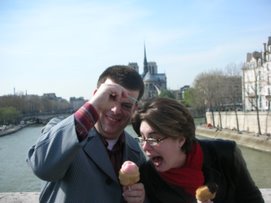
This isn't historic, it's just the cafe where I get coffee on the way to work. It's on the Ile Saint Louis, one of my favorite parts of Paris. The apartment Sara and I stayed at for our first five days in Paris this year is two doors down.
Until recently, I thought the next historical plaque I pass on my commute was the saddest, the most tragic, in Paris. It reads: "To the memory of the 112 residents of this building, among them 40 small children, 'deported and dead' in 1942 in the German camps." If you didn't get it before, you get it now: history is not something you read about in books here, it's not something you take a field trip to visit in a yellow school bus, it's all around you here. Understand it, appreciate it, mourn it--you couldn't avoid it if you wanted to.The reason that the plaque above is no longer the most tragic one I know is because a week or so ago, the gate to that building was open (the building, ironically and almost viciously, is home to one of the city of Paris' public baths and showers). In the courtyard of the building, I found the plaque below. It doesn't simply state the total numbers of the dead, it names names--"Mr. and Mrs. Adoner and their five children," "the Galowski brothers," "the widow Wiorek and her six children." This is literally heartbreaking, ugly and hateful beyond comprehension.

Interestingly, this interior plaque, more recent, avoids the passive "dead" of the older plaque outside, stating that the listed individuals were deported "because they were born Jewish, innocent victims of Nazi barbarity, with the active complicity of the Vichy [pro-Nazi French] government." This plaque is a good example of France's recent efforts to face their World War II complicity with the Nazis head on, to admit it, and to apologize profusely for it. It's good progress for a nation that too often lingered on proud memories of its brave but too rare Resistance fighters while sweeping the French cooperation in the extermination of France's Jews under the rug.

There is no good way to handle this transition.

Just around the corner is my favorite ice cream place in the world, Berthillon. As explained in a previous blog, they have my favorite ice cream flavor in the world, Caramel au Beurre Sale, or Salted Butter Caramel. To quote myself "It’s so good, it cured my goiter. OK, so I didn’t have a goiter. The Caramel au Beurre Sale is so good it gave me a goiter, then instantly cured it (it’s whimsical, cute-but-dangerous, in that Gavroche-on- the-barricades kind of way). It’s so good, it made me forget the name of whosit, that woman I moved here with. Sally, or something…Seriously, it’s good stuff that makes me happy."
After Berthillon, we leave the island and head to the Right Bank (Sara and I live on the Left Bank, so the commute started there). Just off the river we stumble on our next site, another mansion, but this one two hundred years older than the last one. It was built between 1475 and 1519 (Columbus got to America as construction hit it's midpoint). It was home to the Archbishops of Sens, which kind of helps you understand why hovel-dwelling Parisians decided they had to throw out the Catholic Church at the same time they canned the monarchy. A stray cannonball hit the building and lodged there back in 1830, the date having been subsequently chiseled into the facade. That lousy cannonball predates the Civil War by 30 years. If France doesn't put your sense of history into perspective, nothing will.
One more historic plaque before I get to work: "Bombing of April 12, 1918. German torpedoes. 27 dead, 72 wounded." The plaque is on a nondescript building that replaced the one that was torpedoed. It's two blocks from my office, but I didn't discover it for months after I got here, until I took the crosswalk one to the left of the one I usually take. History is everywhere here, but sometimes you have to look for it.
Last stop--just one block from my office is the Saint Paul church, built between 1627 and 1641 under orders of King Louis XIII. Cardinal Richelieu said the first mass here, five priests were massacred in the church during the Revolution, and a Delacroix painting hangs inside.

After spending even a short time here in France, it's hard to avoid getting wrapped up in a conversation about history. The very first time I came to France, as a high school junior, my French host father made a passing comment over dinner about how young our country was. I took offense, rattling off a long list of wars we'd fought in (how American!). it took me years to understand that this wasn't an insult, it was clear and simple fact. Today, I realize that getting a clearer perspective on the immense depth of French history takes just 45 minutes. But be sure to wear comfortable shoes.

Josh

PS: Obviously, I don't normally need to footnote blog entries, but, for this time, thanks Wikipedia!

Saturday, November 03, 2007

Consummate Commute, or "My Commute is a Beaut' "

Greetings everyone,

Sorry for the extended (month-long!) absence from the blogosphere, but one of the lessons this year has taught us is that Parkinson's Law ("Work expands to fill the time available for its completion.") is sadly true. With little to do, we accomplish little. It's the corollary to the advice "If you want to get something done, give it to a busy person." If you don't want something done, give it to me!
One disclaimer as well: when you read our blog entries (like this one), please don't take them as bragging, or worse, as taunting. We're not gloating about our lives being so great, we're just literally shocked at all the crazy stuff we've run into, and, admittedly yes, how lucky we are to be here. Now, onto the blog...
Of the list of things that I love here in Paris, you would probably expect "my commute" to score fairly low indeed. Well, au contraire, mon frere! I love my commute. I walk to and from work, it's about 2.5 miles each way, it takes about 45 minutes, and as I've mentioned in the blog in the past, I'm usually bopping along to tunes from my iPod (thanks, Mom!). To give you a little chance what it's like, I decided to make this blog into a "virtual" commute. So, put on your walkin' shoes and let's get started.

A couple of blocks after heading out the door, we come to St. Medard Church, the church that looks out on the market that Sara often writes about. It's an attractive but unremarkable gothic church, but what's shocking about it (to an American at least) is its age. The church's construction begain in the 15th Century and was completed in the 18th Century. But dates are just numbers unless you put them into context: it took longer to built this church than it has to build our country, its construction started around the time Christopher Columbus arrived in America, and it was completed around the time that our country was born. Humbling history...

After passing alongside St. Medard and turning a corner, we come across a school whose facade is graced with a historical plaque that honors its namesake. The plaque reads in part "Pierre Alviset, an emblematic figure of the Resistance [...] On June 21 [1944], he wrote in his notebook 'I'm 20 years old, a happy age. I want to become a worthy man and a French citizen. Arrested, he was shot in Domont on August 16." This again reinforces the omnipresence of history in this city, and shows how heroes and leaders can sometimes be the person next door.

A block or two up the hill, glancing right, you can see the Paris Mosque at the end of the street. Built in 1926, the mosque is home to a terrific tea room and a hammam (steam bath) that Sara raves about.
1926?!? Fiddle-dee fee!, you say. Even chez Gibson in DC is older than that. Is that the best Paris can do?!? Well, no. Another block up the street, there's a large door under a stone plaque featuring a knight's helmet with the visor down. If you walk through this archway and down a short corridor you will pop out...in a Roman arena. The arena was built around 200 AD, fell into disuse when the Romans left Paris, had its upper levels dismantled by Parisians seeking free building materials, and eventually was filled in with dirt. Rediscovered in the 19th Century during excavations for a bus parking lot, the arena was subsequently...covered back up and had the aforementioned parking lot built above it after all. But following a second excavation decades later, and a "save the arena" campaign that featured Victor Hugo and a small-change fundraising campaign by schoolkids, the arena was saved and became a tourist destination. In a nutty "worlds colliding," only-in-Paris circumstance, the arena, now a Paris city park, was recently outfitted...with WiFi! What's next, an aqueduct leading to the Centre Pompidou?
Down the street and around the corner, we come across what in most other cities would be one of the gems in the town's touristy crown. But in Paris, this would probably rank somewhere in the 500 to 1000 range on the "most important site" list. Oh, it's only a key example of Louis XV-era architecture, a mansion built in 1701. About this place, Paris would say "Oh, that li'l thing?"
A half block away, at the bottom of the hill, on the outside wall of a post office, is this historical plaque. (Paris has great historical plaques--stay tuned for a "favorite things" blog with some of my other favorites, and I'll highlight a few others here that I see on my commute.) The plaque explains that Louis Braille came up with "Braille" on this very site. Interestingly, Braille's name itself appears in Braille on the plaque, but the plaque's eight feet up, so unless your name is Helen Keller Abdul-Jabbar, good luck with that.


Beyond the post office there's a junior high school. I like to check out the cafeteria menu posted outside the school (shrimp and avocado, creme caramel, really?), plus I enjoy raising an arched eyebrow at the smoking and disaffected young French teens that hang out there. And next to the school? The Paradis Latin, one of Paris' most renowned topless cabarets. Check out http://www.paradis-latin.com/ to get a sense of what it's like. The site's NSFW (not safe for work) as the kids say, or at least it is in the US. It's probably A-OK for France, which is why it's allowed to be next to a junior high school, I suppose. This kind of points out the absurdity of the battle in DC to find someplace 1000 yards (or whatever it is) from a school to relocate the strip clubs displaced by the construction of the Nationals ballpark. 'Cuz if we hide the nudity (and the alcohol), kids will lead a happy, sexless existence until they marry!

A block down and across the street is the Tour d'Argent, a 400-year-old (not a typo) restaurant where, for the first time (supposedly) a fork was used. My commute takes me past the place where they discovered the effing fork! Not only that, whenever someone orders duck (the specialty) here, they get a postcard with the "serial number" for their duck. McDonalds ain't got nothin' on the Tour d'Argent. Over a million "servi" (served).

After crossing the street and walking halfway across a bridge, if you turn left, you'll see...
Well, you'll have to wait to hear what you see (though it's good!), because Sara tells me this blog is too long. I suppose you know how this blog is going to end (there's no "Did Josh make it to work?!?", "Did the General Lee fully jump over that pond?!?" Dukes-of-Hazzard season-end cliffhanger). Or is there? Maybe this entire Paris year was just a dream...
A bientot for the conclusion...
Josh

Friday, October 26, 2007

Hat Lessons

Fall has arrived in Paris in a new way this week. The markets have traded tomatoes and reine claude plums for mushrooms and nuts. Oyster season has arrived and I am constantly tempted by the many varieties of oysters, mussels and scallops that all seem to beg a place at my table.

Fall has always been my favorite season and even without the stunning leaves of home, I am relishing this time before winter. As the nights get longer and the days are tempered by clouds and chill, I find myself settling into a more subdued rhythm, which feels right.

I have traded Halloween plans for Beaujolais Nouveau release night plans and have traded fall fest for plans for a small Thanksgiving dinner with Josh, Matt Carty and perhaps a French couple. I notice now that the street lights don’t turn off until after 8AM and I wonder how much darker it will continue to get.

The temperatures have also dropped here. Paris continues to be significantly chillier than D.C. and the temperatures are now chilly enough to justify a second look at all of the fabulous hats and scarves that the French have elevated to a national treasure.

In the last few weeks, I’ve found myself deciding on two hats. Josh thinks my new black and red hat makes me look like a Muppet or a member of 80s group Devo and he might be right, but I will admit to feeling happily carefree whenever I wear it.

I will also admit, however, that sometimes I worry that Josh and I are just diving off the fashion deep end and that we might return just a bit too weird, even for Adams Morgan. I suppose at least we had the good sense to find each other and not inflict our obvious fashion handicap on a spouse who couldn’t appreciate the artistic, if odd, flare to many of our “pieces” and maybe for at least a while we can claim [in a self-important tone], “Well, it worked in Paris.”

My other hat is a bit more subdued and I found it at the local Monoprix. As I tried it on, I had a French interaction that left me smiling and perhaps a bit more fashionable. I suppose if I had any true fashion sense, I might have been alarmed or insulted, but I was mostly grateful.

I was busy in the accessories aisle making sure my chosen hat would fit on my head, when another customer took a personal interest in my situation. I didn’t ask for her help, but she was clearly very concerned that I was not going to wear the hat correctly. I guess I seemed desperate enough or at least open enough to fashion advice that she then provided an on-the-spot hat tutorial in French on hat wearing. It was a bit rough going at times and she had to repeat a few things several times. She even went as far to place the hat on my head when I wasn’t quite understanding the words she was using. What I do know (after the several times she placed the hat on my head) is that wearing the hat tilted slightly to the right makes it “plus feminine” or “more feminine”.

I suppose I missed my chance to have some scarf help. Maybe next week, I’ll stumble through the scarf aisle and another French woman will take pity (or take charge) of my scarf wearing. But for now, I'm grateful that a kind French woman saved me from myself (at least partially) and even if I never wear hats exactly right, that the little hat lesson reminded me of how welcoming the French are, even to a cheerful American Fashion accident.

Happy Halloween and Happy Fall!

sPg

Wednesday, October 10, 2007

Beef Tongue and Smiles

“It is a true pleasure to peel a tongue.”

This comment was made at a lunch I was sharing with several women, after I told them about my most recent of kitchen endeavors—the cooking of an entire cow’s tongue.

Josh and I are adventurous eaters, but we didn’t just stumble on the idea of eating beef tongue. We were going to try our hand because Josh loved it as a child when his grandmother made it and we figured it was probably easier to locate and buy here than in the States. We timed our experiment to coincide with Bobi’s most recent visit and ordered it from our local butcher in time for a Monday lunch.


We picked it up and brought home a seemingly enormous piece of meat. We did our best to figure out what to do with this new and slightly alien-esque cut. To be honest, I could hardly even look at it until it was entirely cooked and carved, which is a rare reaction for me. I was proud of myself for even being willing to try it.

Using Grandma Dotty’s recipe, and with Josh taking the lead, we boiled it for several hours, peeled it and sliced it. In the end, it resembled a normal roast and it wasn’t too bad, even if the texture was a bit off for me.


All in all, the tongue experiment went as well as possible. But, even though I didn’t really like it that much, it was one of the best meals we’ve had because this one single meal has opened the doors to a new level of acceptance of us in Paris.


The tongue meal has perhaps made the most difference in our relationship with our butcher. At least a few times each week since we’ve arrived, I have gone to the same small butcher shop to order a few pork chops, a whole chicken, a steak or whatever it is that Josh and I were eating that evening. The two butchers there were always somewhere between polite and surly, but I knew not to take it personally. I was very happy with the quality and price, which was enough.


Well, since “the tongue”, I am a true regular and accepted member of the butcher’s customer base. I was shocked at how their demeanor changed immediately the first time I visited after we cooked the tongue. With entirely new smiles, the two butchers and the cashier all wanted to know what I thought. One butcher even came out from the back room to see what the American thought. I wisely thought that a little stretching of my enjoyment was OK here. I explained how it was “very interesting” and then listened intensely to the cooking tips they suggested for the next time around.

I said I was surprised how expensive it was since it was about the same price as a pork roast, but agreed when they said it was a good deal when you considered that you could it all of it and there was little waste.

They even went on to talk about pigs' feet and pigs' ears, which were also being featured at the butcher shop that day. Since I have eaten pigs' feet in the Bahamas, I could even offer some thoughts and I think they were surprised to see an American woman who knows five words of French, know anything about untraditional cuts of meat.

The second revelation of my new reputation at the butcher came the next time I went to pick up a few slices of ham for a picnic. All smiles and “Ca Va’s?” were exchanged. I got the ham and went to pay. Realizing that I didn’t have enough in cash, I wanted to pay with a debit card and the woman at the counter (who has only nominally acknowledged me the 60 or so times we’ve interacted since January), smiled and said, “Why don’t you pay tomorrow?”

I picked up my jaw from the ground and said, “Its OK?” She said, “Its normal.” She then wrote down my last name and said, “Comme Mel Gibson, oui?” Rather than getting into any Mel Gibson's ideological thoughts I said, “A bit, but I prefer my husband to him.” And off I went, with a receipt and the promise to bring six euros back tomorrow.

But beyond the butcher, the tongue paid dividends at Iris’s table. I was helping Iris, her two sisters and a long time friend (all of whom were two generations my senior), cook for a birthday party. We were eating lunch before we launched into the work and somehow I had a feeling the tongue would be a good conversation piece. I can also keep up with French easier if the topic is food, so I offered that I cooked it.

Could I have even guessed there were so many different opinions and genuine appreciation for this often unloved piece of meat?

After a heated conversation, I promised to use tarragon and tomatoes the next time I cooked it and attempted to explain that Josh preferred pickled tongue. But what really mattered is that I now felt included in a real way. I felt included by a group of French cooks and by a group of women who had seen a lot in their lives. I felt so included that when I was later told that my potato peeling technique wasted too much potato and my meatballs needed to be much tighter, I knew this was advice to the apprentice in the kitchen and was to be respected.

Photo: In front of Iris' house.

So, I suppose that tongue will cross my table again. Josh loves it and so does Bobi. I know that “Grandma Dotty’s” tongue recipe is something I need to know how to cook so that food memory is never lost, even if I never love the taste. Perhaps I can even manage to look at it the next time. But I think I can safely say, even with these wonderful conversation gifts from my French tongue experience, I will never, ever know the joy and true pleasure of peeling a tongue--that little joy will always belong to Josh alone.

sPg


Monday, October 01, 2007

Bootscraper, bootscraper, scrape me a boot...


As promised in a previous blog entry, here’s another in my new series of “favorite things,” the small stuff in Paris that I love, and that means so much more to me than its literal role or purpose.

Getting ready to write up today’s “favorite things” entry, I remembered a literary reference I'd almost forgotten about that indirectly captures a bit of what these things mean for me. It was a scene from Marcel Proust’s “Remembrance of Things Past,” in which he first as a child discovers the taste of tea-soaked Madeleine cookies, then, decades later, rediscovers the taste plus the flood of memories that come back to him based on the earlier sensory experience (anyone who has seen the Disney movie "Ratatouille" will recognize this same kind of situation from the final scene with the restaurant critic).

“But when from a long-distant past nothing subsists, after the people are dead, after the things are broken and scattered, taste and smell alone, more fragile but more enduring, more unsubstantial, more persistent, more faithful, remain poised a long time, like souls, remembering, waiting, hoping, amid the ruins of all the rest; and bear unflinchingly, in the tiny and almost impalpable drop of their essence, the vast structure of recollection.” (see the full text at http://www.haverford.edu/psych/ddavis/p109g/proust.html)

None of my “favorite things are quite that visceral, but whenever I see one, I do flash back to the first time I saw it, and how and why it resonated with me that first time.

So, to transition, sometimes a boot scraper is not just a boot scraper.

FAVORITE THING #2: BOOT SCRAPERS

Sometimes outside of churches, residential, or commercial buildings, just above ground level, you will see a flat, u-shaped piece of metal, edge up, with both ends attached to the wall or in a small recess. It took me a while to notice these in the first place, and even longer to figure out why they’re there. Now that I’ve gotten to the bottom of the mystery, I love to spring it on visitors.

Basically, for much of Paris’ existence, its roads literally ran with mud, filth, and human/animal waste. You can imagine what happened when peoples’ shoes, encrusted with this junk, crossed your portal into your home, business, or church. Not pretty. But by installing this one piece of cheap and easy metal, you at least give people a chance to lessen the impact the state of their footwear will end up having wherever they tread.

I don’t think much of anyone continues to use the boot scrapers (with the possible exception of those with the misfortune of stepping in dog poop), but I think it’s great fun to see them still in place, a tiny but resonant reminder of how life was lived in Paris centuries earlier.

In the coming weeks, stay tuned for more "favorite things" blogs, a rant about Jim Morrison, a photo essay on my commute to work, and a theory of Sara's and mine regarding how the Devil helps make Paris so great...

A bientot,

Josh