 When we last left our hero, the tension couldn't have been higher, as he...was walking to work.
So, to catch you up, we just passed La Tour d'Argent, birthplace of the fork...
After crossing the street and walking halfway across a bridge, if you turn left, you'll see the sight in the photo below. Not much visible there--only Notre Dame, the Eiffel Tower, and the bridge where Sara and I got engaged! I mean, are you kidding? On my commute, I get to see two of EARTH'S best-known and beloved sites, plus the place where I asked my wife to marry me???
 Admittedly, the Eiffel Tower is far away. You can see it better in this night shot. Since 2000, the Eiffel Tower has these little flickery lights that twinkle every hour on the hour for about five minutes. I use this feature to determine if I'm on time or running late on my way home.
 This isn't historic, it's just the cafe where I get coffee on the way to work. It's on the Ile Saint Louis, one of my favorite parts of Paris. The apartment Sara and I stayed at for our first five days in Paris this year is two doors down.
Until recently, I thought the next historical plaque I pass on my commute was the saddest, the most tragic, in Paris. It reads: "To the memory of the 112 residents of this building, among them 40 small children, 'deported and dead' in 1942 in the German camps." If you didn't get it before, you get it now: history is not something you read about in books here, it's not something you take a field trip to visit in a yellow school bus, it's all around you here. Understand it, appreciate it, mourn it--you couldn't avoid it if you wanted to. The reason that the plaque above is no longer the most tragic one I know is because a week or so ago, the gate to that building was open (the building, ironically and almost viciously, is home to one of the city of Paris' public baths and showers). In the courtyard of the building, I found the plaque below. It doesn't simply state the total numbers of the dead, it names names--"Mr. and Mrs. Adoner and their five children," "the Galowski brothers," "the widow Wiorek and her six children." This is literally heartbreaking, ugly and hateful beyond comprehension.
Interestingly, this interior plaque, more recent, avoids the passive "dead" of the older plaque outside, stating that the listed individuals were deported "because they were born Jewish, innocent victims of Nazi barbarity, with the active complicity of the Vichy [pro-Nazi French] government." This plaque is a good example of France's recent efforts to face their World War II complicity with the Nazis head on, to admit it, and to apologize profusely for it. It's good progress for a nation that too often lingered on proud memories of its brave but too rare Resistance fighters while sweeping the French cooperation in the extermination of France's Jews under the rug.

There is no good way to handle this transition.
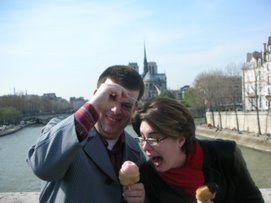
Just around the corner is my favorite ice cream place in the world, Berthillon. As explained in a previous blog, they have my favorite ice cream flavor in the world, Caramel au Beurre Sale, or Salted Butter Caramel. To quote myself "It’s so good, it cured my goiter. OK, so I didn’t have a goiter. The Caramel au Beurre Sale is so good it gave me a goiter, then instantly cured it (it’s whimsical, cute-but-dangerous, in that Gavroche-on- the-barricades kind of way). It’s so good, it made me forget the name of whosit, that woman I moved here with. Sally, or something…Seriously, it’s good stuff that makes me happy."
 After Berthillon, we leave the island and head to the Right Bank (Sara and I live on the Left Bank, so the commute started there). Just off the river we stumble on our next site, another mansion, but this one two hundred years older than the last one. It was built between 1475 and 1519 (Columbus got to America as construction hit it's midpoint). It was home to the Archbishops of Sens, which kind of helps you understand why hovel-dwelling Parisians decided they had to throw out the Catholic Church at the same time they canned the monarchy. A stray cannonball hit the building and lodged there back in 1830, the date having been subsequently chiseled into the facade. That lousy cannonball predates the Civil War by 30 years. If France doesn't put your sense of history into perspective, nothing will.
One more historic plaque before I get to work: "Bombing of April 12, 1918. German torpedoes. 27 dead, 72 wounded." The plaque is on a nondescript building that replaced the one that was torpedoed. It's two blocks from my office, but I didn't discover it for months after I got here, until I took the crosswalk one to the left of the one I usually take. History is everywhere here, but sometimes you have to look for it.
Last stop--just one block from my office is the Saint Paul church, built between 1627 and 1641 under orders of King Louis XIII. Cardinal Richelieu said the first mass here, five priests were massacred in the church during the Revolution, and a Delacroix painting hangs inside.

After spending even a short time here in France, it's hard to avoid getting wrapped up in a conversation about history. The very first time I came to France, as a high school junior, my French host father made a passing comment over dinner about how young our country was. I took offense, rattling off a long list of wars we'd fought in (how American!). it took me years to understand that this wasn't an insult, it was clear and simple fact. Today, I realize that getting a clearer perspective on the immense depth of French history takes just 45 minutes. But be sure to wear comfortable shoes.
Josh
Admittedly, the Eiffel Tower is far away. You can see it better in this night shot. Since 2000, the Eiffel Tower has these little flickery lights that twinkle every hour on the hour for about five minutes. I use this feature to determine if I'm on time or running late on my way home.This isn't historic, it's just the cafe where I get coffee on the way to work. It's on the Ile Saint Louis, one of my favorite parts of Paris. The apartment Sara and I stayed at for our first five days in Paris this year is two doors down. Until recently, I thought the next historical plaque I pass on my commute was the saddest, the most tragic, in Paris. It reads: "To the memory of the 112 residents of this building, among them 40 small children, 'deported and dead' in 1942 in the German camps." If you didn't get it before, you get it now: history is not something you read about in books here, it's not something you take a field trip to visit in a yellow school bus, it's all around you here. Understand it, appreciate it, mourn it--you couldn't avoid it if you wanted to.
The reason that the plaque above is no longer the most tragic one I know is because a week or so ago, the gate to that building was open (the building, ironically and almost viciously, is home to one of the city of Paris' public baths and showers). In the courtyard of the building, I found the plaque below. It doesn't simply state the total numbers of the dead, it names names--"Mr. and Mrs. Adoner and their five children," "the Galowski brothers," "the widow Wiorek and her six children." This is literally heartbreaking, ugly and hateful beyond comprehension.Interestingly, this interior plaque, more recent, avoids the passive "dead" of the older plaque outside, stating that the listed individuals were deported "because they were born Jewish, innocent victims of Nazi barbarity, with the active complicity of the Vichy [pro-Nazi French] government." This plaque is a good example of France's recent efforts to face their World War II complicity with the Nazis head on, to admit it, and to apologize profusely for it. It's good progress for a nation that too often lingered on proud memories of its brave but too rare Resistance fighters while sweeping the French cooperation in the extermination of France's Jews under the rug.
There is no good way to handle this transition.
Just around the corner is my favorite ice cream place in the world, Berthillon. As explained in a previous blog, they have my favorite ice cream flavor in the world, Caramel au Beurre Sale, or Salted Butter Caramel. To quote myself "It’s so good, it cured my goiter. OK, so I didn’t have a goiter. The Caramel au Beurre Sale is so good it gave me a goiter, then instantly cured it (it’s whimsical, cute-but-dangerous, in that Gavroche-on- the-barricades kind of way). It’s so good, it made me forget the name of whosit, that woman I moved here with. Sally, or something…Seriously, it’s good stuff that makes me happy."
After Berthillon, we leave the island and head to the Right Bank (Sara and I live on the Left Bank, so the commute started there). Just off the river we stumble on our next site, another mansion, but this one two hundred years older than the last one. It was built between 1475 and 1519 (Columbus got to America as construction hit it's midpoint). It was home to the Archbishops of Sens, which kind of helps you understand why hovel-dwelling Parisians decided they had to throw out the Catholic Church at the same time they canned the monarchy. A stray cannonball hit the building and lodged there back in 1830, the date having been subsequently chiseled into the facade. That lousy cannonball predates the Civil War by 30 years. If France doesn't put your sense of history into perspective, nothing will. One more historic plaque before I get to work: "Bombing of April 12, 1918. German torpedoes. 27 dead, 72 wounded." The plaque is on a nondescript building that replaced the one that was torpedoed. It's two blocks from my office, but I didn't discover it for months after I got here, until I took the crosswalk one to the left of the one I usually take. History is everywhere here, but sometimes you have to look for it.
Last stop--just one block from my office is the Saint Paul church, built between 1627 and 1641 under orders of King Louis XIII. Cardinal Richelieu said the first mass here, five priests were massacred in the church during the Revolution, and a Delacroix painting hangs inside.
After spending even a short time here in France, it's hard to avoid getting wrapped up in a conversation about history. The very first time I came to France, as a high school junior, my French host father made a passing comment over dinner about how young our country was. I took offense, rattling off a long list of wars we'd fought in (how American!). it took me years to understand that this wasn't an insult, it was clear and simple fact. Today, I realize that getting a clearer perspective on the immense depth of French history takes just 45 minutes. But be sure to wear comfortable shoes.
Josh
PS: Obviously, I don't normally need to footnote blog entries, but, for this time, thanks Wikipedia!




 Posts
Posts


No comments:
Post a Comment