
[continued from previous post, regarding papers I accidentally bought at a Paris flea market that detail the betrayal of Dr. Salzberger by his landlords, the Lavergnes, during the Holocaust]
THEIR VERBATIM ACCOUNTS
Most of the papers in the bundle fall into two categories: statements from Dr. Salzberger about what happened and what goods he was trying to recuperate, and statements from the Lavergnes as well as Erich Kahnt, the Nazi who was sleeping with Georgette.
Most of the papers in the bundle fall into two categories: statements from Dr. Salzberger about what happened and what goods he was trying to recuperate, and statements from the Lavergnes as well as Erich Kahnt, the Nazi who was sleeping with Georgette.
For the most part, Dr. Salzberger's statements are tragic in their banality. Other than a few brief references to his suffering or the deportation of his sister-in-law, he mainly focuses on writing detailed lists of what was taken from him, and what he is trying to get back. Having survived World War II, imprisonment in a German prisoner of war camp, the loss of virtually everything he owns, and the likely death of his sister-in-law, the enormity of it all is seemingly too much for his fragile psyche to take. Perhaps, by obsessing about missing rugs, broken windowpanes, and cut electrical wires, he can lose himself in the obsessive minutiae and put off confronting the horrifying reality of the war and its aftermath for some time.
It is in reading the Lavergnes' statements that the archetypes of wartime Parisians really come out. Madame Lavergne was a true Nazi sympathizer, often stating to her husband that “the Germans are every bit as good as the French,” and referring to her daughter's Nazi lover as “her son-in-law.”
 Monsieur Lavergne was, or at least claimed to be, on the side of the Allies. According to him, he would get in frequent fights with his wife, so he'd leave, go up to their “chambre de bonne,”and listed to the British news on the radio. He claimed not to know until quite late that his daughter Georgette was sleeping with a Nazi. However, he did still benefit personally from his wife's denunciation of Salzberger, and dealt heavily in the black market.
 Georgette seems not to have taken sides on the war, other than deciding to sleep with the Nazi in the first place.
 Amazingly, other than Salzberger himself, the Nazi Erich Kahnt probably garners the most sympathy in his statement. The one and a half pages of his statement outline how he met Georgette in 1940, was separated from her when he was sent to the Russian front in 1941, then, suffering from “two frozen feet and kidney sickness,” returned to Paris in 1942 and was reunited with his lover. He tells of how he avoided being detained at the time of the Liberation in 1944, remained there incognito at his own risk, and how he scoured the city in search of Georgette. In his statement, he writes that “When I learned Georgette had been arrested, I again felt, for one distraught moment, the deep feelings I had for this person who had given me the strength to stay in Paris, and to await her freedom, despite this perpetual anxiety.”
 LOOSE THREADS
Unfortunately, just as suddenly as this fascinating story came to my attention, the narrative comes to an uncertain end. Based on these documents alone, it is impossible to find out if Helene survived the concentration camps, what happened to Melchior (the documents say both were arrested by the Gestapo but that only Helene was sent to the camps), what became of the Lavergnes, and whether or not Salzberger ever got his belongings returned to him.
 In one bit of good news: also in my bundle of documents was a postcard sent from Haifa, Israel just ten months after Israel gained its independence, bearing one of the first stamps ever issued by Israel, addressed to “Mr. And Mrs. Salzberger” at the old Boulevard Sebastopol” address.
  The documents provide tantalizing clues (there are case numbers listed that are tied to Salzberger's legal and criminal filings), but despite some frenzied research in our final days in Paris, I was unable to make any progress.
 While the cast of characters and the first half of the story have now been plucked out of the obscurity of lost history, the end of the story remains unknown.
POSTSCRIPT
Some people spend their whole lives combing flea markets seeking discoveries like this one. Admittedly, the papers I found are not the equivalent to finding an initial draft of the Declaration of Independence hidden in an old picture frame, or a lost Edgar Allan Poe manuscript behind an old bookcase. Still, these documents, with their brevity, clear clues for future research, and compelling anecdotes and cast of characters, would certainly be compelling to collectors of World War II and Holocaust history.
Still, I could not bring myself to sell the documents. Somehow, that just seemed like taking advantage of Dr. Salzberger's suffering for a second time, just like the Lavergnes did initially. More than a half century later, I wanted to reinforce what Salzberger did in pursuing his betrayers. To share the facts, not to hide them.
While still in France, I contacted the US Holocaust Memorial Museum, and described the documents I had found. They responded with great interest. Just two weeks after returning to the States, I met with Museum Archivist (surprisingly younger than me, and Catholic!), and her interest in the documents only grew when she had actually seen them. She mentioned that the Museum plans an exhibition on Vichy France sometime around 2011, and that my documents could be of interest to the curators who will assemble that exhibit. I signed the documents over to the Museum that same day.
In return, I received a CD with the scanned images of all the documents I donated (that is how I could post some of them here), plus high-quality printouts of the documents. And, as I found out when I first started looking into the possibility of donating the documents, we also get to deduct from our taxes the anticipated value of the documents. This is why Sara has to take it easy on me, and not give me too hard of a time about spending too much time and money at flea markets.
However, much more importantly, these documents, and this fascinating history, will no longer languish tucked in a plastic sleeve, tossed in an old cardboard box, at a French flea market. They will be available to researchers and possibly even the relatives of those involved in the events themselves. I am proud that in my own infinitesimal way, I have helped make sure that we “never forget” the Holocaust.
Josh


 First, there is the author of most of the documents, Doctor Nathan Salzberger. He lived and had his offices on Boulevard Sebastopol, not far from where the Centre Pompidou stands today. From the documents, it seems like he served in the French army as a doctor, but was captured at some point, and was held in a military prison in Germany before being released to live in southern France.
  THE WICKED LAVERGNES
 Standing in the way of their moneymaking scheme, however, were Salzberger's brother and sister-in-law, who were still hiding out in the “maid's room” at the time. The documents detail how Madame Lavergne told the Nazis about the two Jews living upstairs, how she accompanied them up to the sixth floor, and how, when the Nazis almost stopped short and decided to leave, she urged them to keep going. They walked up the few extra steps, broke down the door, and arrested Melchior and Helene. Helene was then sent to the temporary prison camp of Drancy, a way station on the trip to the concentration camps. According to Dr. Salzberger's handwritten testimony, “her poor physical state left no hope of her survival.”
  One anecdote from the documents demonstrates the depth of the Lavergnes' depravity. At some point following Dr. Salzberger's release from the military prison, but just prior to the Lavergne's betrayal of his brother and sister-in-law, Melchior and Helene entrust the Laverges with a suitcase to sent to Dr. Salzberger in the south of France. In a report written after the war's end, Salzberger outlines the suitcase's original contents in meticulous detail: “a blue suit, a blue gabardine overcoat, three shirts, three pairs of long underwear, five pairs of socks, two pairs of shoes, six ties, one scarf, twelve collars, and a hat.” However, when the suitcase arrived in the south of France, Salzberger was shocked to open the bag and find a used German suit on top of the rest of the suitcase's disappointing new contents: carrots and turnips. The Lavergnes had taken the suitcase from Melchior, promised to send it to Dr. Salzberger, then stole its contents. They replaced the missing clothes with the vegetables (likely rotting) to mask the missing weight, and one of Nazi Erick Kahnt's old suits on top to lend the appearance that the suitcase was full of the promised clothes.

 I will always associate the concept of "serendipity" with Paris. One very literal reason is that on Sara's and my engagement trip to Paris in 2005, we splurged and had a grotesquely overpriced drink at the renowned Hemingway Bar at the Ritz. The cocktail consists of one part calvados (French apple brandy), two parts apple juice, and seven parts champagne, with a sprig of mint. The cocktail is called a Serendipiti. [sic].
 The other, bigger picture reason that I associate serendipity with Paris is that I can not imagine a more serendipitous city than Paris. "Stuff" just happens there, but not the bad stuff.
 Frankly, this blog could have been called "His and Hers Serendipity," because many of our posts deal with the very fortunate and very accidental discoveries of our year in Paris. But on an even more micro level than we discussed in the blog, you can get a sense of the inherent serendipity of Paris through the tiny coincidences captured through my photography.
 I've talked a bit in past blogs about my love of photography. Only one thing makes me as excited, happy, passionate, interested, proud, and maddened like photography. OK, maybe there's one other trigger for these same feelings, but I'm married to her...
 So much of photography is being at the right place at the right time. It's all about location, location, location. It looks like I'll get a chance to exhibit my photos at Tryst coffeehouse here in Adams Morgan this fall, and I'm thinking of calling the exhibit "Fish in a Barrel: A Year of Paris Photography," just because Paris is just such a great place for serendipitous photography.
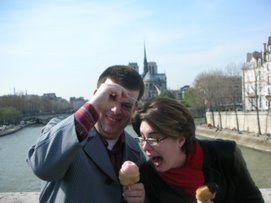
 I'm including some of my favorite such photos here. I hope you like them.
 Photography is a bit like fishing, in that you always remember "the one that got away." To crib a bit from Langston Hughes, what happens to the serendipity that got away? Well, it doesn't dry up like a raisin in the sun, it just irritates the royal crap out of you. One example is in this photo:
  just moments after I snapped this photo (does one still "snap" photos in the era where cameras no longer "snap"?), the model very clearly and deliberately gave me the finger. It would have made for a great photo, but frankly, she caught me so flatfooted that it never even occurred to me to take a picture.
 A guy walked onto the street and past the romantic couple. I was waiting for him to walk by me and out of the shot, so I could take the picture. But, unexpectedly, once he walked past the couple, he took a hard left, went under the scaffolding you see in the picture, and...proceeded to urinate. It would have been a great "tale of two cities"/"best of times, worst of times" photos, but frankly, at the time, I was just irritated him at holding up my taking a photo of the couple.
  I guess, if nothing else, our year abroad taught us that serendipity giveth, and serendipity taketh away.
 Josh
Josh


 The plot would involve a luggage handler (and thief) at Charles DeGaulle Airport who gets caught red-handed, and is then drafted by the French secret services into working with them. The film will either be called “The Spy” or “A Simple Spy.” (Check out its Internet Movie Database web page here:


 [Caption: The scene of the crime.]




 Posts
Posts

